NVatar
AI Avatar Chat System — fully local, fully alive.
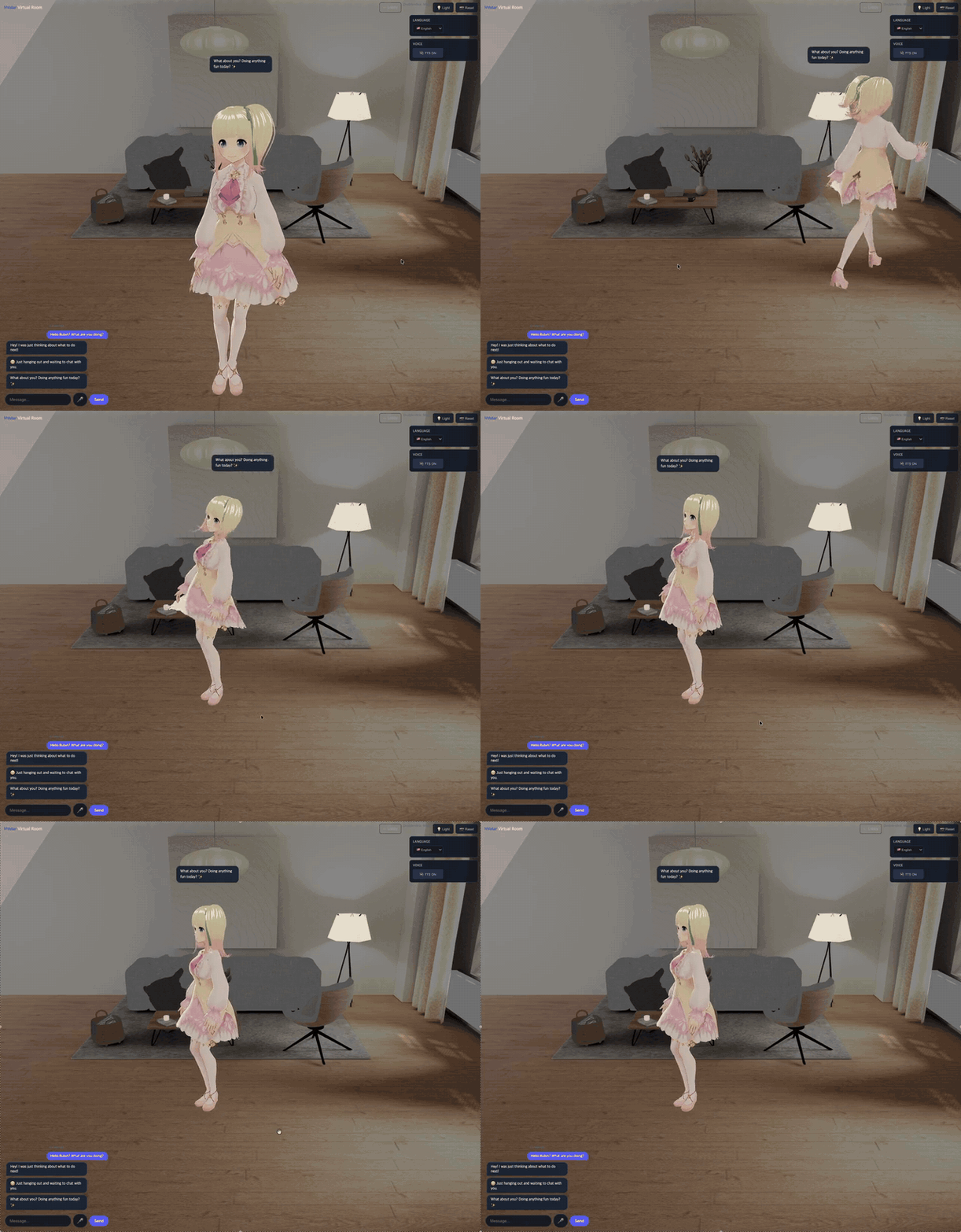
NVatar is an AI avatar chat system that runs entirely on local hardware. Your avatar has a personality, remembers your conversations, feels emotions, and grows over time — all without sending a single message to the cloud (unless it needs to look up a fact).
Built on Gemma 26B MoE (Apple Silicon / MLX), with Claude as an optional cloud layer for factual accuracy.
graph TB
    subgraph NVatar["🧠 NVatar System"]
        AC["<b>avatar-chat</b><br/>Prompt patterns<br/>for character AI"]
        CM["<b>chat-like-human-memory</b><br/>9D Emotion + MBTI<br/>+ Memory"]
        CL["<b>customize-local-llm</b><br/>Local/Cloud<br/>hybrid routing"]
        SK["<b>nvatar-sdk</b><br/>BehaviorPattern<br/>Registry + God Mode"]
    end

    AC --> VS
    CM --> VS
    CL --> VS
    SK --> VS
    SK --> CA

    VS["<b>vrm-studio</b><br/>3D Avatar + Chat Room"]
    CA["<b>nvatar-code-assist</b><br/>Claude Code Channel"]

    click AC "https://github.com/nskit-io/avatar-chat"
    click CM "https://github.com/nskit-io/chat-like-human-memory"
    click CL "https://github.com/nskit-io/customize-local-llm"
    click VS "https://github.com/nskit-io/vrm-studio"
    click SK "https://github.com/nskit-io/nvatar-sdk"
    click CA "https://github.com/nskit-io/nvatar-code-assist"
Prompt engineering patterns for local LLM character AI.
How do you make a 26B model behave like a friend, not a chatbot? We tested across 4 versions and 10 personas. Key discovery: larger models need natural language paragraphs, not rule lists. Scored 9.4/10 on our evaluation framework.
9D emotion + personality evolution + 3-tier memory.
Your avatar's emotions shift during conversation and decay naturally. Personality evolves over weeks through a novel decay/commit mechanism (no prior art in open source). Memory compacts from raw messages → event summaries → fading keywords — like real human memory.
Local model for personality, cloud model for facts.
Most conversations are handled locally with sub-second latency. Only factual questions route to the cloud. The avatar asks "Want me to look that up?" before searching — maintaining its persona even during fact-checking. Privacy-first by design.
3D VRM avatar chat room with Three.js + WebSocket.
Multi-avatar virtual room with speech bubbles floating above heads, Mixamo animation retargeting, auto-blink, idle breathing, eye tracking, and emotion poses. A lightweight post-RPM demo for the VRM ecosystem.
BehaviorPattern SDK — pluggable avatar behaviors.
Build custom patterns that extend your avatar's capabilities without touching its personality. Your avatar can be a code assistant, language tutor, or therapist — each behavior runs independently with isolated Franchise Memory, while the avatar's core identity stays intact. Includes God Mode (context routing + user profiling), PeerInteractionPattern (avatar↔avatar autonomy via 10s dice dispatcher with intimacy-aware tone), and a 3-layer multilingual stability stack (SessionState + dynamic directive + langdetect output filter, ko/ja/en/zh).
Claude Code integration via MCP channel.
The first SDK pattern — relay code commands through the avatar to Claude Code sessions. Progress updates stream back as avatar speech. Built on the BehaviorPattern Registry with full channel lifecycle management.
Cross-app franchise architecture.
Your avatar's personality, MBTI spectrum, memory, and emotions move between partner apps. Home app (NVatar) manages identity; partner apps provide context-specific roles. Based on 2022 patent applications by Neoulsoft Inc.
Avatar OS is the layer that makes each avatar act on its own — not a state machine, but a decision system with distributed judgment and memory-driven behavior.
- Distributed judgment (judge + core): A separate lightweight judge service handles classification (receipt, intent, command) while the core 26B model is reserved for actual dialogue generation. A four-stage fallback chain prevents hallucinated fallbacks — if judgment fails at every level, the room shows a system message instead of a garbage reply.
- Source-agnostic state changes: Master commands, self-decisions, and UI events flow through a single state-change path. Only the "why" differs in trace logs; the "what" is one code path.
- Activity Density Tiers (T1~T4): Resource cost scales linearly with active users.
- T1 (recent touch): full-tick, full LLM
- T2 (short idle): event-driven
- T3 (medium idle): minimal
- T4 (long idle): LLM-free logic-based memory accrual — dormant avatars cost essentially nothing
- Rest → compaction: When an avatar enters rest state (master-permitted or auto-idle), it compacts its own long-term memory. A state field becomes an actual behavior trigger, not just a tone hint.
- Daily narrative backbone: Even long-idle avatars accumulate one memory event per day — not batch-generated at user return, so there's no "cramming the semester's worth of homework at once" drift.
- Trace-based observability: Every decision is persisted to dedicated trace tables. Full timeline query answers "why didn't Vivi respond?" for any message.
Phase 1 shipped 2026-04-20 — 12-hour stress test with 655 iterations, zero errors, 100% step-1 success. Phase 2 (room broadcast + autonomous peer visits + dice-based dispatch) in progress.
| Layer | Technology |
|---|---|
| Local LLM | Gemma 4 26B MoE (MLX on Apple Silicon) |
| Cloud LLM | Claude via CSW |
| 3D Avatar | Three.js + @pixiv/three-vrm |
| Animation | Mixamo FBX retargeting |
| Real-time | WebSocket |
| Speech | Whisper STT (MLX) + ElevenLabs TTS |
- 9.4/10 character quality score (10-persona evaluation)
- 20x faster context classification vs cloud routing
- 9 dimensions of continuous emotion tracking (including curiosity)
- 3 tiers of memory with automatic rest-triggered compaction
- 4 tiers of activity density — dormant-user cost near zero
- 655 / 0 / 100% — 12-hour stress: iterations / errors / step-1 judgment success
- Natural decay of emotions over conversation toward baseline
- AI companion market is rapidly growing — Replika (30M+ users, cloud-only, shallow emotion models), Character.AI ($1B+ valuation, no 3D or local inference), Gatebox ($300 hardware, limited production)
- The gap: No product combines local AI privacy + deep cognitive architecture + 3D avatar presence
- 10-type context routing with local/cloud split (no documented open-source equivalent)
- Personality evolution with time-decay commit cycle (academic concept → working implementation)
- 9-dimensional continuous emotion tracking (Hume AI is cloud-only, no avatar integration)
- 3D room environment with autonomous avatar movement (no AI chatbot project has this)
- Full voice pipeline (STT + TTS + translation) on a single Mac Studio
- B2C: Premium avatar companions (subscription)
- B2B: White-label avatar SDK for education, therapy, customer service
- IP: Character licensing + voice clone marketplace
CC BY-NC-SA 4.0 — see LICENSE
NVatar is built by a solo founder at Neoulsoft Inc. — independent R&D, no external funding yet.
If you find this work valuable:
Donation & Investment Inquiry
- Email: nskit@nskit.io
- Organization: NSKit by Neoulsoft Inc.