Find structurally duplicate functions in Go code.


godedup detects copy-pasted Go functions even when variable names, literals, and package calls were changed.
godedup ./...HTML output
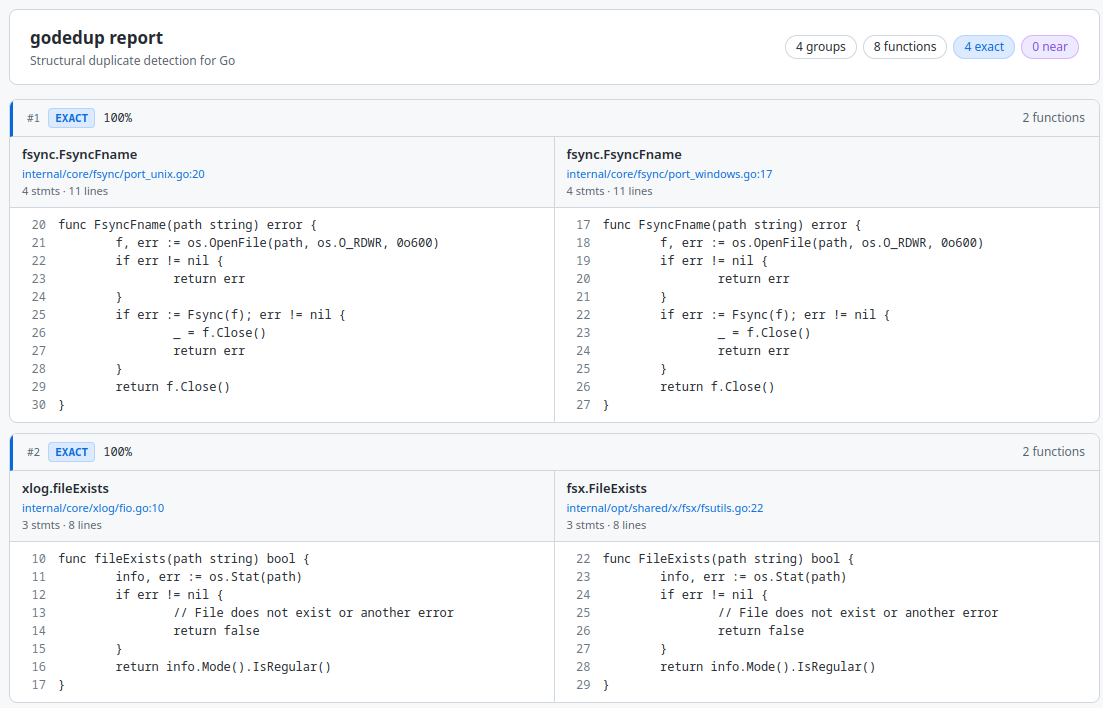
Table output with clickable file.go:line locations in supported terminals and editors
$ godedup --output=table --exclude '_test\.go$'

GROUP  TYPE   SIM   FUNCTION                     LOCATION                     STMTS  LINES
------------------------------------------------------------------------------------------
1      EXACT  100%  store.(*UserRepo).findByID   internal/store/user.go:84    5      14
1      EXACT  100%  store.(*OrderRepo).findByID  internal/store/order.go:91   5      14
------------------------------------------------------------------------------------------
2      EXACT  100%  api.writeJSON                internal/api/user.go:31      4      9
2      EXACT  100%  api.writeJSON                internal/api/order.go:28     4      9
------------------------------------------------------------------------------------------
3      NEAR   88%   worker.(*EmailJob).validate  internal/worker/email.go:55  7      19
3      NEAR   88%   worker.(*SMSJob).validate    internal/worker/sms.go:48    8      21
godedup hashes every function's AST structure, normalizing away:
- Identifier names -
userIDandorderIDare treated the same - Literal values -
"users"and"orders"are treated the same - Package qualifiers -
fmt.Printlnandlog.Printlnare treated the same
Two functions that do the same thing with different variable names, different string literals, and different package calls hash identically.
Exact clones - top-level hash collision: identical control flow and structure.
Near clones - edit distance on per-statement hash sequences: same structure with a few added/removed statements.
go install github.com/hashmap-kz/godedup@latestbrew tap hashmap-kz/homebrew-tap
brew install godedupgodedup [flags] [path ...]
Examples:
godedup ./...
godedup --exact ./...
godedup --exclude '_test\.go$' --exclude '\.pb\.go$' ./...
godedup --exclude '(_test|[.]pb|[.]deepcopy)[.]go$' ./...
godedup --output table ./...
godedup --output html ./... > godedup.html
godedup --output json ./... | jq .
Flags:
--min-similarity float minimum similarity threshold (default: 0.85)
--min-stmts int minimum statements to analyze (default: 3)
--exact report only exact structural clones
--exclude exclude files matching regexp (may be repeated)
--output string output format: text, table, html, json (default: text)
--version print version
JSON output for custom tooling:
godedup --output=json ./... | jq '.[] | select(.exact) | .functions[].name'| What | How normalized |
|---|---|
| Variable names | all -> same token |
| String literals | all -> "" |
| Numeric literals | all -> 0 |
| Package qualifiers | fmt.X and log.X -> same structure |
nil / true / false |
preserved (semantic meaning) |
| Operator types | preserved (+ != -) |
| Statement order | preserved (order matters) |
| Control flow structure | preserved (the whole point) |
godedup is intentionally simple. It does not try to prove semantic equivalence.
It finds structural duplication, not all possible duplication.
For example, these may not match:
- same behavior implemented with different control flow
- helper functions extracted in only one copy
- loops rewritten as recursion
- code generated by tools, unless you include it in the scanned paths
MIT License. See LICENSE for details.