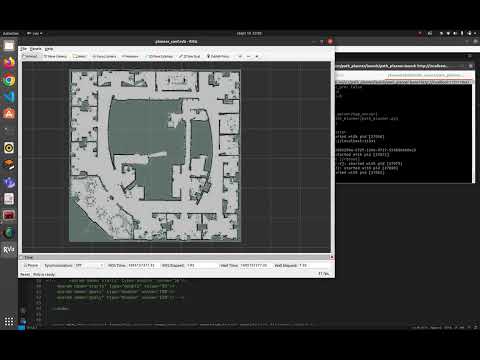
The Path Planner ROS package provides algorithms for optimal path finding (A* and Dijkstra) on grid maps and Probabilistic Roadmap (PRM) models. It features gradient descent smoothing for paths and tools for analyzing graph connectivity.
Clone the repository into your catkin workspace:
cd ~/catkin_ws/src
git clone <your-repository-url>
cd ..
catkin_makeRun the path planner using:
roslaunch path_planner path_planner.launch- Path Finding: Implements A* and Dijkstra's algorithms to find the most efficient path between nodes.
- Path Smoothing: Uses a gradient descent method to smooth paths, reducing sharp turns and unnecessary maneuvers.
- Connectivity Analysis: Analyzes and visualizes the connectivity of PRM graphs to ensure comprehensive path coverage.
Modify parameters in the ROS launch file to tailor the planner's behavior:
heuristic_weight: Adjusts the weight of the heuristic in the A* algorithm.prm_num_nodes: Sets the number of nodes in the Probabilistic Roadmap (PRM).alphaandbeta: Control the smoothing process, balancing between path fidelity and smoothness.
By setting heuristic_weight to zero, A* behaves similarly to Dijkstra’s algorithm. A* typically visits fewer nodes than Dijkstra's, demonstrating its efficiency by using a heuristic to prioritize nodes that are believed to be closer to the goal.
Dijkstra’s algorithm explores a larger number of nodes (depicted in blue) compared to A*.
- Dijkstra’s Algorithm

- A* Algorithm

-
Node Density: Increasing
prm_num_nodesenhances connectivity. This is crucial in complex environments where a higher node density may facilitate finding viable paths. -
200 Nodes: Shows limited connectivity.

-
500 Nodes: Significantly improved connectivity.


Node density is crucial for pathfinding in complex terrains like mazes.
-
500 Nodes: Insufficient for a viable path.

-
800 Nodes: Enhanced node density leading to successful pathfinding.

-
Smoothing Parameters (
alpha&beta): -
alpha: Higher values keep the path close to the initial, rough path. -
beta: Higher values result in a smoother, less angular path. -
High Alpha (0.9, Beta 0.1): Maintains path fidelity.

-
High Beta (0.1, Alpha 0.9): Creates a smoother path.


Watch the video demonstration to see the path planner in action across various tasks and maps. Highlights include connectivity analysis, dynamic adjustments to PRM node counts, and testing the A* algorithm with smoothing on different map types.