Functions created without a name
- Created and assigned to a variable
- The variable acts as the function's name!
- The name of a function created through a declarative function definition is also a variable pointing to the function!
- In JavaScript, all declarations are hoisted
- In the case of function declarations, declaration, initialization, and assignment all occur, making execution possible
- Function expressions undergo variable hoisting resulting in undefined. In other words, they cannot be executed
Callback functions: Functions that are automatically called when a method is executed
Callback functions for array inspection methods
-
forEach-
Used when manipulating elements one by one
-
Passes each element to a callback function for processing
-
Usage
arr.forEach( callback(currentvalue[, index[, array]] [, thisArg]))
function hiUser(element, index, array){
    document.write("<p>Hi " +element+ "!</p>")
}
var users = ["jerry", "tom", "steve"];
users.forEach(hiUser);
-
-
map-
Returns a new array after processing each array element with a callback function
function sayBabyAnmial(animal){
    var result;
    switch(animal){
        case "dog":
            result = "puppy";
        break;
        case "chicken":
            result = "chick";
        break;
        default:
            result = "baby " + animal;
    }
    return result;
}
var animals = ["cat", "dog", "squirrel", "chicken","fox"];
var baby = animasl.map(sayBabyAnimal);
-
-
filter-
Returns a new array with desired elements organized
- Uses a callback function when organizing elements
-
Arguments passed to callback functions when using array object inspection methods
- element
- index
- array
function isBigEnough(element, index, array){
    return (element >= 10);
}
var filtered = [12, 5, 8, 130, 44].filter(isBigEnough);
document.write(filtered.toString()); //12,130,44
-
-
every-
Returns true when all array elements pass the condition presented by the callback function, returns false on failure
function isBigEnough(element, index, array){
    return (element >= 10);
}
var passed = [12, 5, 8, 130, 44].every(isBigEnough); //false
var passed = [12, 54, 18, 130, 44].every(isBigEnough); //true
-
-
some- The logically opposite case of every
- If at least one element satisfies the callback function's requirement: returns true
- If none exist: returns false
- The logically opposite case of every
-
JavaScript === Functional language
-
Scope is set based on functions
-
Function
: Sets its own scope
- Variables declared inside a function => Valid only inside the function
-
- Characteristics of JavaScript functions
- Functions can be passed as arguments
- Functions can be returned
- Functions can be assigned to variables
- The conditions above are the conditions for first-class objects (first class object / first class citizen) in programming languages
- Passing a function as an argument
- Returning a function
: A closure is the combination of a function and the lexical environment (lexical scoping, environment) in which that function was declared
function makeAdder() {
    var x =1
    return function(y){
        return x+y
    }''
}
var add1 =- It remembers the variables that were outside even when inside!!!
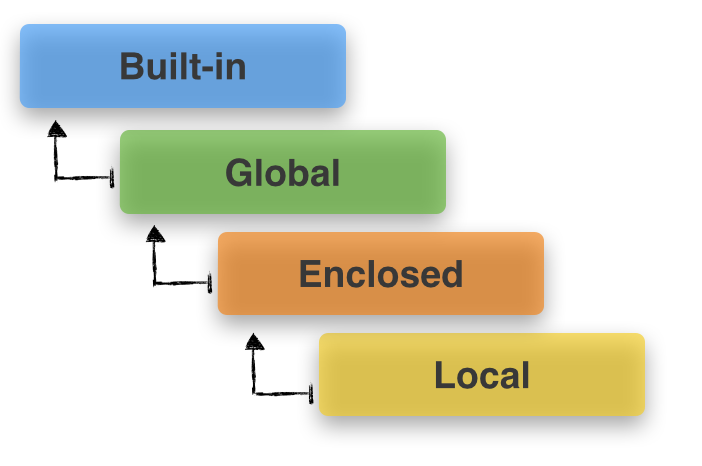
- local
- environment
- global
- build-in